


As artificial intelligence drives a new generation of power-hungry data centres, the engineering challenge is not just about sufficient electricity, but about how data centres can consume energy more intelligently and potentially even help support the grid.
Two perspectives offered a glimpse into how that relationship could evolve: first by optimising what happens inside the data centre, and then by rethinking how the facility interacts with the wider electricity network.
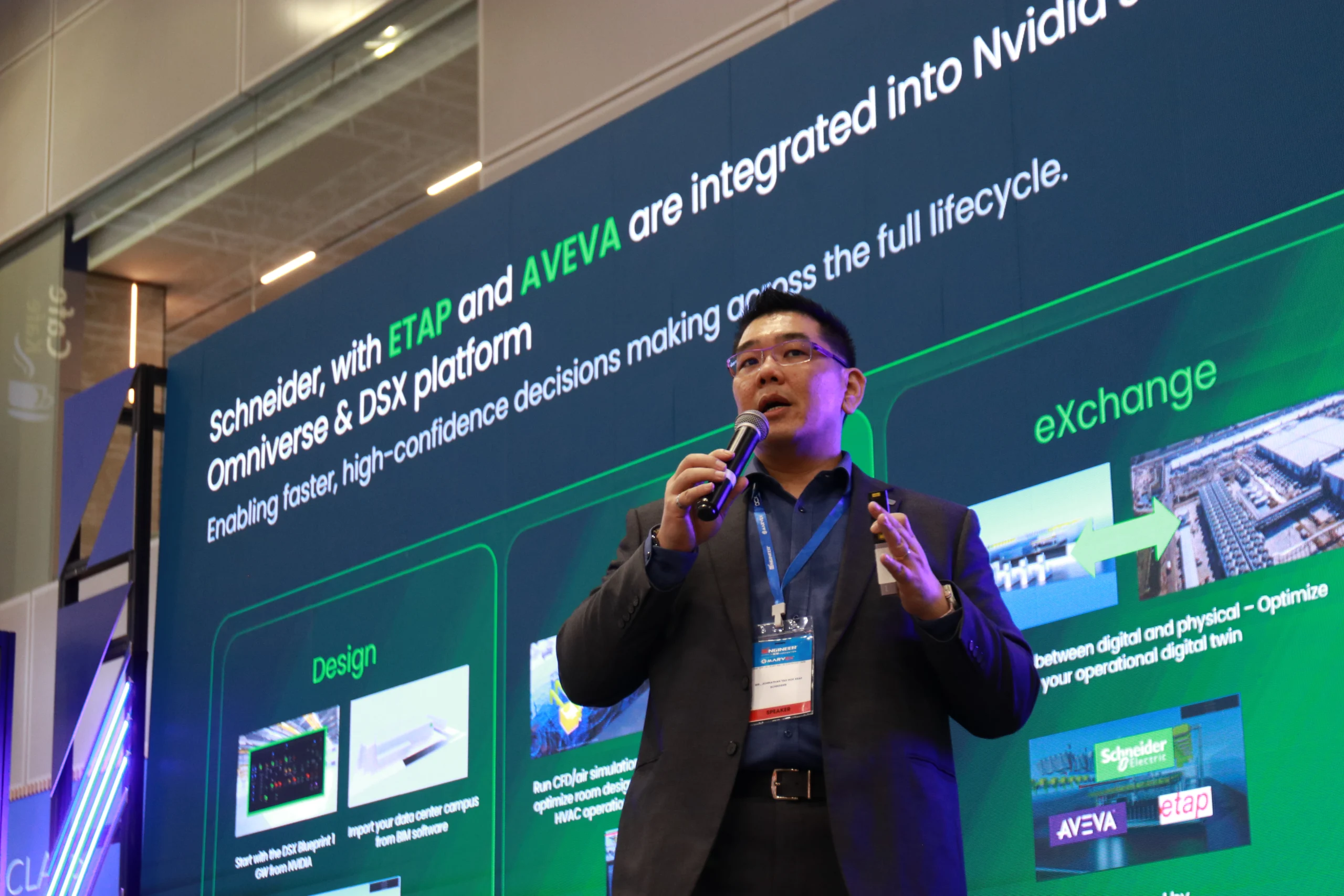
For Jonathan Yau, Data Centre Digital Solutions Lead for East Asia Digital Energy of Schneider Electric, whose work in digital solutions involves mainly data centre clients, digital twins offer operators a way to move beyond static designs and manual calculations towards a dynamic model that follows a facility throughout its lifecycle.
“Digital twin starts from the design stage, then moves into simulation, the build stage and eventually operations,” said Yau.
Rather than relying solely on conventional drawings and calculations, engineers can use the digital model to simulate changes to an electrical network before implementing them physically. During operations, the same model can support optimisation of energy and water consumption, including metrics such as Power Usage Effectiveness (PUE) and Water Usage Effectiveness (WUE), while helping operators minimise downtime.
But optimising energy use within the data centre may only be one half of the equation.
Ir. Ts. Mahesvaran of Lead (Emerging Solutions) of TNBX believes there is also an opportunity to rethink the relationship between data centres and the electricity grid, from one where they are predominantly large power consumers to one where they could potentially become grid-supporting assets.
Data centres typically possess substantial energy infrastructure of their own, including batteries, uninterruptible power supply systems and energy management systems. Mahesvaran said these distributed energy resources could potentially be tapped to provide support back to the grid.
“If you look at data centres, one of the distributed energy resources they have plenty of is batteries. We could tap that potential so that it can contribute back to the grid,” he said.
The proposition could also create a commercial incentive for operators. Mahesvaran suggested mechanisms could eventually include offsetting demand charges or compensating data centres when their available energy resources are called upon to support the grid.
It creates an intriguing possibility when the same data centre that uses digital technology to optimise its own energy performance could one day use its energy assets to support the wider power system and potentially be rewarded for doing so.
For Mahesvaran, ENGINEER MARVEX provides an important platform for these conversations, bringing different areas of engineering expertise together to exchange ideas and explore emerging technologies.